

What Makes a Kayak Fast? The Key Speed Factors Explained

TLDR;
If you’ve ever wondered what actually makes a kayak fast, the answer isn’t one single measurement. Speed comes from a balance of waterline length, width, hull shape, rocker, and how well the paddler can use the boat’s design. This guide explains every factor in simple, practical terms.
You know the moment well.
You line up for a friendly time trial, thinking your kayak is “pretty fast.” The horn blows. You take three powerful strokes… and the guy next to you, same fitness, same paddle, same effort… starts pulling away. Not slowly. Effortlessly.
Ten minutes later, you’re sweating harder, but you aren’t catching up.
It’s the first time you realise:
Speed is not only about fitness — it’s about the hull beneath you.
That moment of confusion is exactly why understanding kayak speed matters.
Speed is a slippery concept. Scientifically, it’s relative, and on the water, it becomes even more subjective. Ask any paddler what “fast” feels like, and you’ll get a spectrum of answers. On one hand, there’s the theoretical hull speed determined by hull shape and fluid dynamics. On the other hand, you have the paddler’s contribution: strength, technique, paddle choice, and stability. Stability, in turn, is a function of the paddler’s balancing skill, but also of the inherent stability of the kayak hull.
This is where things get interesting. Stability affects speed far more than most people realise. Theoretical hull speed means nothing if you’re bracing every second stroke or rolling into the water. If you can’t put 100 percent of your energy into going forward, you’re not in the right kayak.
Racing paddlers often push themselves into more unstable boats to develop balance. That’s a different journey, and a different article. For now, let’s assume the paddler stays the same across all kayaks. Strength, technique, paddle type, balance — constant. That leaves the hull itself: length, width, hull shape (form drag), skin friction and rocker.
Before diving deeper, one caveat: we’re talking about displacement hulls on flat water, which is what most paddlers experience when they go out on the water. Planing hulls and whitewater designs follow a different set of rules.
So what is a displacement hull? In essence, it means the hull does not ride on top of the water; instead, it pushes water out of the way as it moves through it.
Length: The Waterline That Writes the Rules
A kayak’s top-end speed is governed mostly by the length of its effective waterline — the part of the hull actually in the water when you’re paddling normally.
As a displacement hull moves, it creates a wave at the bow and another at the stern, with a trough between them. At slow speeds, multiple smaller waves exist along the hull. As speed increases, the hull settles between one bow wave and one stern wave. Push harder, and the kayak tries climbing over the bow wave, which takes more power than a human can sustainably produce in a paddling craft, where extra power is limited. So, there is no point in trying to move a kayak faster than the speed at which it sits exactly between the two wave crests
Long waves travel faster than short ones. Longer kayaks generate longer waves. Therefore, longer kayaks can achieve higher speeds. When the hull length matches the wavelength it produces, you reach hull speed. For all practical purposes, this represents the maximum speed of the hull.
Width: Narrower Is Faster… Until You Swim
Width affects speed by influencing how much water needs to be pushed aside. A narrower hull displaces less water and produces less drag. A wider hull creates more resistance.
But width is also stability. Designers constantly walk a tightrope: too wide and the paddler wastes energy; too narrow and the paddler wastes time swimming. The ideal width allows the intended paddler to apply full power confidently.
Hull Shape and Form Drag
Hull shape determines how cleanly water flows around the kayak. The two major types of resistance are:
• Wave-making drag, caused by pushing water aside
• Form drag, created by turbulence behind the boat
Smooth transitions, rounded or soft-chined hulls, fine entry lines, and clean releases reduce turbulence and help the kayak glide efficiently. Water hates sudden changes. The smoother the shape, the faster the kayak can be. Even small design changes in the bow and stern can noticeably improve speed.
Skin Friction: Why Slippery Counts
Skin friction results from water moving along the hull’s surface. The boundary layer (the layer of water directly in contact with the hull) sticks to the hull as it moves forward, creating resistance. Hulls with larger surface areas (known as the wetted area) encounter more drag. Therefore, skin friction is directly influenced by the wetted area, as well as by the hull’s finish and how well the water flow remains aligned with the hull. The more of the hull’s surface in contact with water, the greater the skin friction.
Over a short distance, skin friction is minimal. So in the case of a short kayak, the speed limitations mostly come from waterline length, hull shape, and form drag. But as kayaks become longer, skin friction increases even as wave drag decreases. Eventually, the length no longer adds speed because friction cancels out the benefits.
Rounded hulls often have less wetted area than flat ones. Materials also matter: high-performance boats frequently use slick or more durable materials, and composite hulls generally feel quicker than plastic ones. A slippery hull is a fast hull.
Rocker: More Curve, More Control
Rocker refers to the curvature of the hull from bow to stern.
• Low rocker: longer waterline, better tracking, more straight-line speed
• More rocker: improved manoeuvrability, shorter waterline, slightly reduced glide
Extra rocker can also cause a slight zig zag motion from alternating paddle strokes, which adds drag. Open-water kayaks often need just enough rocker to prevent the bow from slapping into waves and to keep the hull running smoothly over chop. The intended environment always determines the best compromise.
The Takeaway: Speed Comes from Harmony
A fast kayak isn’t defined by one feature but by several working in harmony:
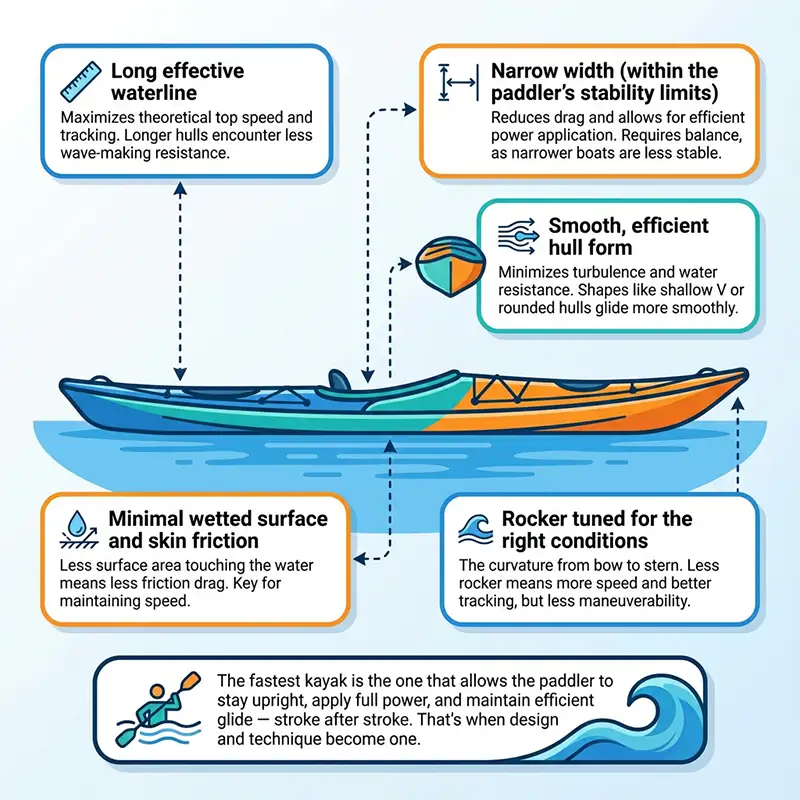
• Long effective waterline
• Narrow width (within stability limits)
• Smooth, efficient hull form
• Minimal wetted surface and skin friction
• Rocker tuned for the right conditions
The fastest kayak is the one that allows the paddler to stay upright, apply full power, and maintain efficient glide — stroke after stroke. That’s when design and technique become one.
Frequently Asked Questions
Q: What factors make a kayak fast?
A kayak’s speed depends on waterline length, width, hull shape, rocker, and skin friction. All these elements work together to reduce drag and improve glide.
Q: Is a longer kayak always faster?
Yes, in most cases. A longer waterline lets the kayak create longer waves, which move faster. But extremely long kayaks gain friction and may not be faster for all paddlers.
Q: Does a narrower kayak go faster?
Narrower kayaks create less drag and are generally faster, but only if the paddler can stay stable enough to apply full power.
Q: What is hull speed in kayaking?
Hull speed is the maximum practical speed a displacement kayak can reach before it starts trying to climb the bow wave, which requires far more power.
Q: How much does rocker affect speed?
More rocker improves manoeuvrability but reduces straight-line speed. Low rocker gives better tracking and glide.